Dr Isabelle LITTLE, mbe (1889–1969)
Pioneering GP
2 Holywell Street, Oxford
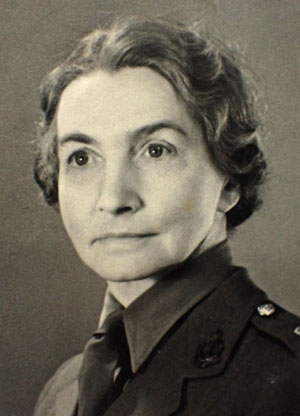
© by courtesy of Juliet Morton
Isabelle Little first came to Oxford in 1919 as a young unmarried doctor, at a time when there was no NHS, and in a male-orientated world. She was one of Oxford’s first female GPs and became a pioneer in establishing family planning and supporting and serving the psychiatric hospitals. Isabelle’s legacy to Oxford and Medicine is remarkable.
Isabelle was of Scottish ancestry, born to John and Barbara Little in 1889 near Lockerbie. Her mother died when she was two and her father took up a job as Land Agent to Lord Derwent in Hackness near Scarborough. She and her sister Jan were brought up by an aunt and their father. She attended schools in Scarborough. At the age of 18 she got a scholarship to train as a doctor in Edinburgh and graduated in 1912 as a B.M., Ch.D. After doing several medical “house jobs” she became a Regimental Medical Officer during World War I. In 1919 she applied for GP jobs at both Oxford and Cambridge and chose Oxford.
She joined a women's partnership in the city with Dr Dorothea C. Nasmyth (née Maude) at 5 Holywell. Later Isabelle bought the practice and ran it from 2 Holywell (below) which she rented in May 1928 from Merton College until 1961. She was joined in 1936 by Dr Frances Nichol.

She enlisted as a Royal Army Medical Officer during World War II and became a captain. She retired from the practice in 1962 and lived at 87 Woodstock Road. Towards the end of her life she moved to Mansfield, Nottinghamshire.
In April 1926 Dr William Collier, Senior Physician in Oxford, convened a meeting to discuss the creation of a Birth Control clinic in Oxford. Mrs John Masefield chaired the meeting. In the early 1920s there was wide-scale poverty in Oxford. Families were often large, living in cramped housing with poor sanitation. To enable married women to have contraception would be a major force for social change. It would allow women to limit their pregnancies and thereby help stop crippling poverty, control their lives, get jobs, and make choices. Opposition however was substantial. Despite this, later that year the “Council of Oxford Family Welfare Association” was established, and Isabelle became one of the two doctors who worked voluntarily at the clinic for two evenings a week. This was initially in rented rooms and then in a house in Jericho, where it stayed for 20 years until it found its due place in the Radcliffe Infirmary. In the early years of fighting for this change the doctors had to shoulder intense opposition and were often accused of being “wicked”. It was for this pioneering work that she was awarded the MBE in 1968.
Isabelle had special interest in psychiatry, and she served on the management committee of the Warneford and Park Hospitals from 1951. In 1960 she was made deputy chairman of the management committee, later becoming acting chairman, and she remained so until its amalgamation in April 1968 into the Isis group with Littlemore and other hospitals. This was a very difficult period in the history of the Warneford and Park hospitals, and her concern, her imperturbability, her tact, and above all her understanding of the whole situation and how it affected all those concerned contributed outstandingly to the smoothness of the transition.
Isabelle (or Toby to her friends and family) was a steadfast Christian and this underpinned everything she did. Although she remained unmarried, she opened her house to her sister and her nephew John (then aged ten) when in December 1926 her sister’s clergyman husband died. In time, John also became a doctor, as did eight of his direct descendants. In the words of Professor Bullock, “Hers was a life which for 50 years was devoted to healing and to helping others.”
Juliet Morton (great-niece)
Sources:
- Sources: Obituary in the British Medical Journal, Vol. 2, No. 5660 (28 June 1969), p. 828
- Little I., “40 years back”, Family Planning Magazine, Vol 15, No 3, October 1966
- Bullock A., Oxford Mail, “Letters to the editor”, 5 June 1969
- Family knowledge
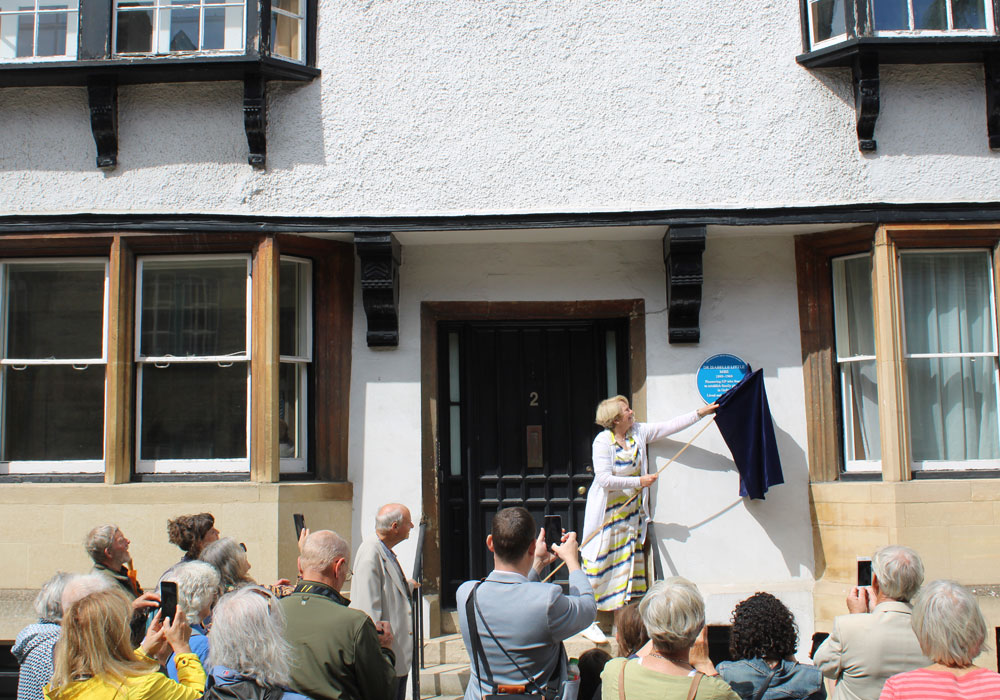
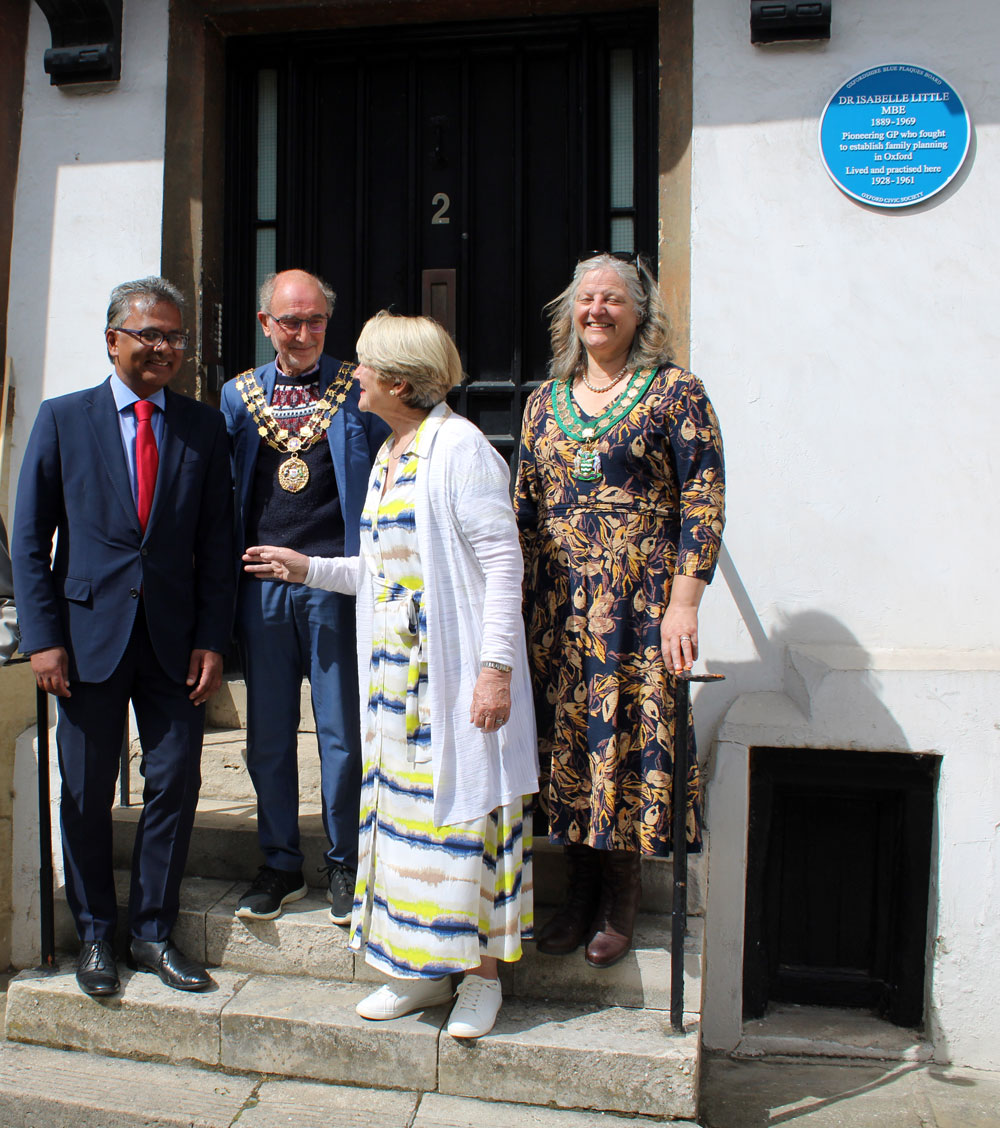
The plaque was unveiled at 2 Holywell Street, Oxford on 6 July 2024 by Mrs Juliet Morton, Dr Little’s great-niece. Among those attending were Cllr James Fry (Sheriff of Oxford), Cllr Keira Bentley (Chair of Vale of White Horse District Council), Dr Karl Marlowe (Chief Medical Officer of Oxford Health NHS), and members of Dr Little’s family.
Photographs taken at the ceremony:
- Mrs Juliet Morton unveiling the plaque
- Members of Dr Isabelle Little's family
- Dr Karl Marlowe, Cllr James Fry, Mrs Juliet Morton, and Cllr Keira Bentley
Oxford Mail, 11 July 2024: “Blue plaque honours one of Oxford's first female GPs”
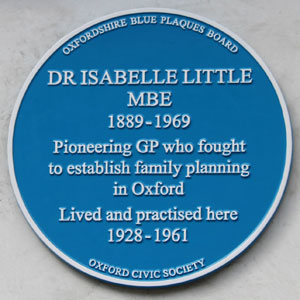
Oxfordshire Blue Plaques Board
DR ISABELLE LITTLE
MBE
1889–1969
Pioneering GP who fought
to establish family planning
in Oxford
Lived and practised here
1928–1961
Oxford Civic Society