

Frederick ETCHELLS (1886–1973)
Artist, architect, writer
The Thatched Cottage, West Challow
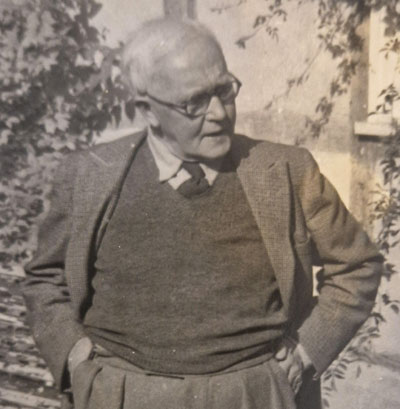
© By courtesy of Patrick Wyatt
Born in Newcastle, the son of John Charles Etchells, engineer, and his wife Jessie (née Anderson), he grew up in Macclesfield and attended the Royal College of Art in London. He then went to Paris and sought out leading modernist figures, Modigliani, Picasso, and Braque. In London he associated with the Bloomsbury Group, especially Roger Fry, and worked with his Omega Workshop. Clive Bell remembered him at this time as ‘having red hair and always surrounded by suffragettes’. With Wyndham Lewis he went on to launch the Rebel Art Centre and the modernist manifesto publication Blast. He exhibited at the centre as a member of the Vorticist group.
After war service, he embarked on a career as an architect, working mainly on traditional buildings in Mayfair and Belgravia for the Grosvenor Estate but he also seized on the chance to design the first fully modernist office building in central London at 232–234 High Holborn (Grade II). He was invited to translate Le Corbusier’s Vers Une Architecture. His translation Towards a New Architecture is now a classic, well known to generations of students. He made occasional contributions to the Architectural Review and under the pseudonym Batty Langley contributed letters to Betjeman’s Ghastly Good Taste.
In the 1930s his interest turned to restoring medieval churches such as West Dean in Sussex and many others. The restoration of Holy Trinity, Donnington, near Chichester, led to his collaboration with G. O. Addleshaw, later Dean of Chester, on The Architectural Setting of Anglican Worship (1948). John Betjeman refers to his handling of traditional materials such as oak, stone, and stained glass as close to genius.
In 1932 he had married Hester Margaret Sainsbury, artist and dancer, and they moved out of London to East Hagbourne, living at France House which he had restored. They next moved to West Challow, to Holm Lea, now called Challow Mead, in 1937. While living there in 1939 he bought the two cottages now comprising The Thatched Cottage (below) for £37 and applied himself to rescuing them from condemnation over a period of five years.
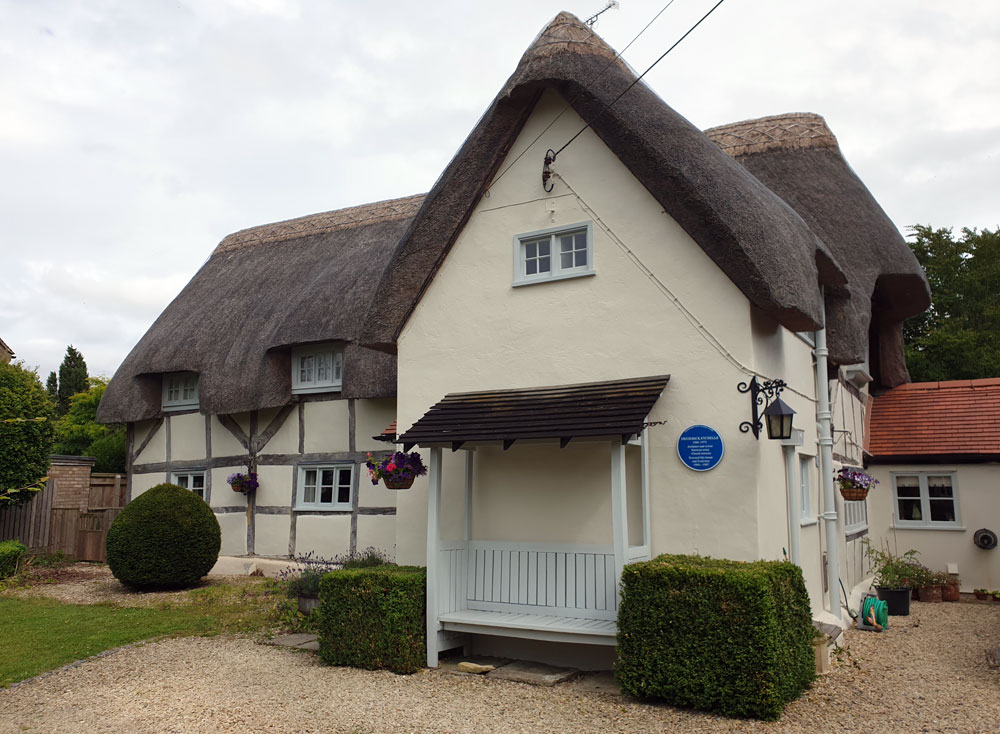
They lived at The Thatched Cottage 1944–c.1967. When Hester died, Etchells retired to Heather Lodge in Folkestone and died there in 1973.
Etchells deserves much credit for campaigning with the Society for the Protection of Ancient Buildings in 1949 to save the village of Letcombe Bassett from dereliction and demise when the local authority considered the provision of a main drain not worth the expense. A public enquiry found in favour of the residents and Letcombe Bassett was saved from extinction. The village had become a focus of national interest and a test case for the survival of other similar places in rural England.
Sources:
- Oxford Dictionary of National Biography, article by Nicholas Bullock
- Building Conservation Year Two by Malcolm Dickson (2005)
The plaque was unveiled at The Thatched Cottage on 20 July 2024. The speakers were Malcolm Dickson, an authority on Frederick Etchells, and Patrick Wyatt, Etchells’ grandson. The ceremony was attended by Cllr Elizabeth Poskitt (Chair of West Oxfordshire District Council) and local residents.
Photographs taken at the ceremony:
- Malcolm Dickson and Patrick Wyatt unveiling the plaque
- Professor Robert Evans (Chairman of the Oxfordshire Blue Plaques Board), Malcolm Dickson, Jim Trotter (owner and proposer of the plaque), and Patrick Wyatt
- Patrick Wyatt, local residents, and Cllr Elizabeth Poskitt
Speech made by Malcolm Dickson at the ceremony

Oxfordshire Blue Plaques Board
FREDERICK ETCHELLS
1886–1973
Architect and writer
Vorticist artist
Church restorer
Rescued this house
and lived here
1944–1967


